
Navy Midshipmen vs Air Force Falcons, College Basketball Picks

All stats are publicly graded and pulled from real sportsbook accounts.
Tail MotorCityAnalytics
Model Projection
These numbers come from a power-rating model built on the method Billy Walters lays out in his book Gambler, seeded from ESPN's own real college basketball power index.
Projected Spread
AF -1.5
No real live market line available yet.
Projected Total
140
No real live market line available yet.
Projected Moneyline
AF -120
No real live market line available yet.
This projection and current market action are supplementary and do not influence the final qualitative pick and analysis of today's game.
Season stats ordered from most to least relevant. Longer bar, stronger league standing.
NAVYAF
Matchup Breakdown
Navy's offense: Navy scores at a well-above-average clip and shoots the ball with genuine efficiency from the field and beyond the arc, ranking among the better shooting teams in Division I. Their ball movement is a real strength, with assist totals near the top of the country.
Air Force's offense: Air Force is one of the lowest-scoring teams in all of Division I in the 2025-26 season, and the problems run deep. They shoot poorly from every spot on the floor, turn the ball over at a punishing rate, and rank last in the country at the free throw line.
Navy's defense: Navy's defense is among the very best in Division I, holding opponents to a historically low scoring average that places them just outside the top five nationally. They are active on the perimeter and secure defensive rebounds at a solid rate.
Air Force's defense: Air Force's defense has serious problems across the board in the 2025-26 season, allowing opponents to score at a rate that ranks near the bottom of Division I. They give up offensive rebounds at an alarming rate and generate very few steals or blocks.
Overall: Navy brings a much more complete team into this matchup, with a sharp offense running into one of the worst defensive units in the country, and a lockdown defense facing an Air Force offense that struggles to generate points against anyone. Air Force has no obvious path to covering the gap in quality on either side of the ball.
Scorer Matchup
Each team's real detected leading scorer, and how he has actually played.

Jinwoo Kim
G · NAVY
2025-26 season numbers
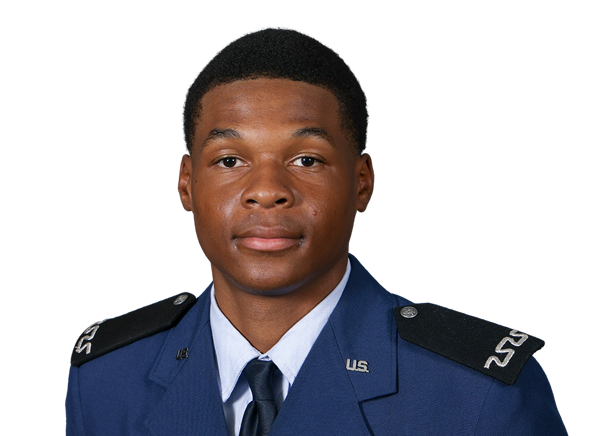
Kam Sanders
G · AF
2025-26 season numbers
The Read
Navy's leading scorer: Jinwoo Kim is a secondary scoring option who has been a reliable perimeter shooter in the 2025-26 season, connecting at a solid rate from three. He adds modest rebounding and playmaking but does not carry a heavy offensive load.
Air Force's leading scorer: Kam Sanders is a more well-rounded contributor in the 2025-26 season, scoring at a higher clip while also generating assists and pulling down boards at a noticeably better rate than Kim.
The efficiency: Kim has been the cleaner scorer from an efficiency standpoint, shooting more accurately from both the floor and the free-throw line, while Sanders has been less precise overall but brings more volume and playmaking to offset it.
Overall: Sanders holds the real individual edge here, producing more points, more assists, and more rebounds than Kim across the 2025-26 season. Kim's shooting accuracy is the one area where he genuinely outperforms his counterpart, but that advantage does not close the overall gap. As leading scorers for their respective teams, both are role players rather than primary options, so neither matchup figures to be a game-defining one-on-one battle.
Team Conditions
Schedule rest, recent form, and the current injury report.
NAVYAF
Rest
Standard preparation, 3 days rest.
4 days since the last game, real extra rest.
Form
2025-26 record 26-8 (home 15-2, road 10-5)
2025-26 record 3-29 (home 3-15, road 0-12)
InjuryKey Players
None reported
None reported
The Read
Navy's availability: The injury report is quiet, with no meaningful absences to account for.
Air Force's availability: The injury report is equally quiet, with no players flagged as missing or limited.
Rest and form: Air Force had an extra day of preparation coming in, while Navy arrives on a standard turnaround. Navy has been a productive team across the 2025-26 season, though their recent stretch has included some losses mixed in with wins. Air Force has had a difficult 2025-26 season overall, though they have shown they can pick up wins, including a couple of recent ones.
Overall: Navy enters as the far stronger side by season record, posting a winning mark that includes consistent success on the road, while Air Force has struggled to win away from home all season and carries a losing record overall. The extra rest for Air Force is a minor positive, but it does not close the gap between where these two teams actually stand. On paper and in recent performance, Navy is in the better position heading into this game.
Side Write-Up
Air Force covers as the home side in a game where the numbers strongly favor Navy as the better team across the board in the 2025-26 season, and that tension is exactly where the spread value lives. Navy's offense ranks among the better shooting units in Division I, their ball movement sits near the top of the country in assists, and their defense holds opponents to a historically low scoring average that places them just outside the top five nationally. Air Force, meanwhile, is one of the lowest-scoring teams in all of Division I, shoots poorly from every spot on the floor, turns the ball over at a punishing rate, and ranks last in the country at the free throw line. Their defense in the 2025-26 season has allowed opponents to score at a rate near the bottom of Division I, surrendering offensive rebounds at an alarming rate while generating almost no steals or blocks. The strongest counterargument is that Air Force arrives with an extra day of rest and has shown they can pick up wins in the 2025-26 season, including a couple of recent ones, which gives them a live window to stay competitive at home. That extra rest and home floor are real, but they do not change the structural mismatch between a Navy team with a winning road record and an Air Force side carrying a losing record overall and no reliable way to generate points or stop them on defense. The spread number has not been posted yet, but the evidence points to Air Force covering as the team receiving points against a Navy squad that is better across nearly every measurable dimension.
Final PickAir Force Falcons
Total Write-Up
Two factors pull this total toward the under and they reinforce each other rather than working in opposite directions. Air Force is one of the lowest-scoring teams in all of Division I in the 2025-26 season, and their offensive problems touch every category: poor shooting from every spot on the floor, a punishing turnover rate, and dead-last free throw production in the country. When Air Force does get the ball moving, they hand it back through turnovers, cutting into possession counts and scoring opportunities. Navy's defense then layers on top of that, holding opponents to a historically low scoring average that sits just outside the top five nationally, with an active perimeter and solid defensive rebounding that eliminates second-chance points. Even Navy's own offense, while sharp and efficient, is running into an Air Force defense that ranks near the bottom of Division I in points allowed, so the game is unlikely to accelerate into a high-possession shootout on either end. The leading scorers for both teams, Jinwoo Kim and Kam Sanders, are role players rather than primary options, meaning neither side has a volume scorer capable of single-handedly inflating the number. The strongest counterargument is that Navy's efficient offense, ranked among the better shooting teams in Division I with strong ball movement, could find consistent openings against an Air Force defense that gives up offensive rebounds at an alarming rate and generates very few stops. That is a real concern, but Air Force's offensive floor is so low, and Navy's defense so active, that the ceiling on total scoring in this game is capped well below what a typical college basketball total requires.
Final PickUnder

Written by
Trevor Nolan
This information is for entertainment purposes only and is not any form of financial or gambling advice. Sports involve high variance therefore always be responsible and manage your risk accordingly.
All stats are publicly graded and pulled from real sportsbook accounts.
Tail MotorCityAnalyticsOther Games Today

 NCAABToday's Top Picks, Ranked›NCAAB
 VS
 Queens University Royals vs Houston Cougars4:00 PM ET›NCAAB
 VS
 Utah State Aggies vs New Mexico Lobos2:00 PM ET›NCAAB
 VS
 South Florida Bulls vs Saint Louis Billikens3:30 PM ET›NCAAB
 VS
 Memphis Tigers vs Dayton Flyers1:00 PM ET›NCAAB
 VS
 Lipscomb Bisons vs Ohio State Buckeyes5:30 PM ET›NCAAB
 VS
 Tennessee State Tigers vs Oklahoma State Cowboys3:00 PM ET›NCAAB
 VS
 Drake Bulldogs vs North Texas Mean Green4:30 PM ET›NCAAB
 VS
 Eastern Washington Eagles vs Wyoming Cowboys3:00 PM ET›NCAAB
 VS
 Milwaukee Panthers vs Oregon State Beavers2:00 PM ET›NCAAB
 VS
 Portland Pilots vs Stanford Cardinal4:00 PM ET›NCAAB
 VS
 Howard Bison vs Charleston Cougars2:00 PM ET›NCAAB
 VS
 North Dakota State Bison vs Boise State Broncos4:00 PM ET›NCAAB
 VS
 Incarnate Word Cardinals vs Grand Canyon Lopes8:00 PM ET›NCAAB
 VS
 West Florida Argonauts vs Florida State Seminoles3:00 PM ET›NCAAB
 VS
 Davidson Wildcats vs Florida Atlantic Owls2:00 PM ET›NCAAB
 VS
 Nicholls Colonels vs Texas State Bobcats5:00 PM ET›NCAAB
 VS
 Western Carolina Catamounts vs Charlotte 49ers3:00 PM ET›NCAAB
 VS
 Loyola Chicago Ramblers vs Massachusetts Minutemen1:00 PM ET›NCAAB
 VS
 Vermont Catamounts vs Hofstra Pride2:30 PM ET›NCAAB
 VS
 William & Mary Tribe vs James Madison Dukes4:00 PM ET›NCAAB
 VS
 Dartmouth Big Green vs App State Mountaineers1:00 PM ET›NCAAB
 VS
 Quinnipiac Bobcats vs Yale Bulldogs2:00 PM ET›NCAAB
 VS
 Norfolk State Spartans vs Washington Huskies7:30 PM ET›NCAAB
 VS
 IU Indianapolis Jaguars vs Tulsa Golden Hurricane2:00 PM ET›NCAAB
 VS
 Rice Owls vs Arkansas State Red Wolves2:00 PM ET›NCAAB
 VS
 Merrimack Warriors vs Colgate Raiders12:00 PM ET›NCAAB
 VS
 South Dakota State Jackrabbits vs Fresno State Bulldogs6:00 PM ET›NCAAB
 VS
 Radford Highlanders vs UMass Lowell River Hawks1:00 PM ET›NCAAB
 VS
 Canisius Golden Griffins vs UIC Flames1:30 PM ET›NCAAB
 VS
 Morehead State Eagles vs East Tennessee State Buccaneers4:00 PM ET›NCAAB
 VS
 Niagara Purple Eagles vs Maine Black Bears12:00 PM ET›NCAAB
 VS
 UL Monroe Warhawks vs Tulane Green Wave2:00 PM ET›NCAAB
 VS
 North Dakota Fighting Hawks vs Green Bay Phoenix2:00 PM ET›NCAAB
 VS
 Central Connecticut Blue Devils vs Fairfield Stags2:00 PM ET›NCAAB
 VS
 New Hampshire Wildcats vs Holy Cross Crusaders2:00 PM ET›NCAAB
 VS
 NJIT Highlanders vs Sacred Heart Pioneers2:00 PM ET›NCAAB
 VS
 West Georgia Wolves vs South Carolina Upstate Spartans2:00 PM ET›NCAAB
 VS
 Le Moyne Dolphins vs Lafayette Leopards2:30 PM ET›NCAAB
 VS
 Maryland Eastern Shore Hawks vs Longwood Lancers3:00 PM ET›NCAAB
 VS
 UTSA Roadrunners vs SIU Edwardsville Cougars4:00 PM ET›NCAAB
 VS
 Hampton Pirates vs American University Eagles4:00 PM ET›NCAAB
 VS
 Grambling Tigers vs Southern Miss Golden Eagles4:00 PM ET›NCAAB
 VS
 Iona Gaels vs Bryant Bulldogs4:00 PM ET›NCAAB
 VS
 Tarleton State Texans vs Texas Southern Tigers4:00 PM ET›NCAAB
 VS
 Florida Gulf Coast Eagles vs LSU New Orleans Privateers5:00 PM ET›
Promos for Your Next Bet
Current offers for your area. Pick your region and the list updates.
Select Your Location